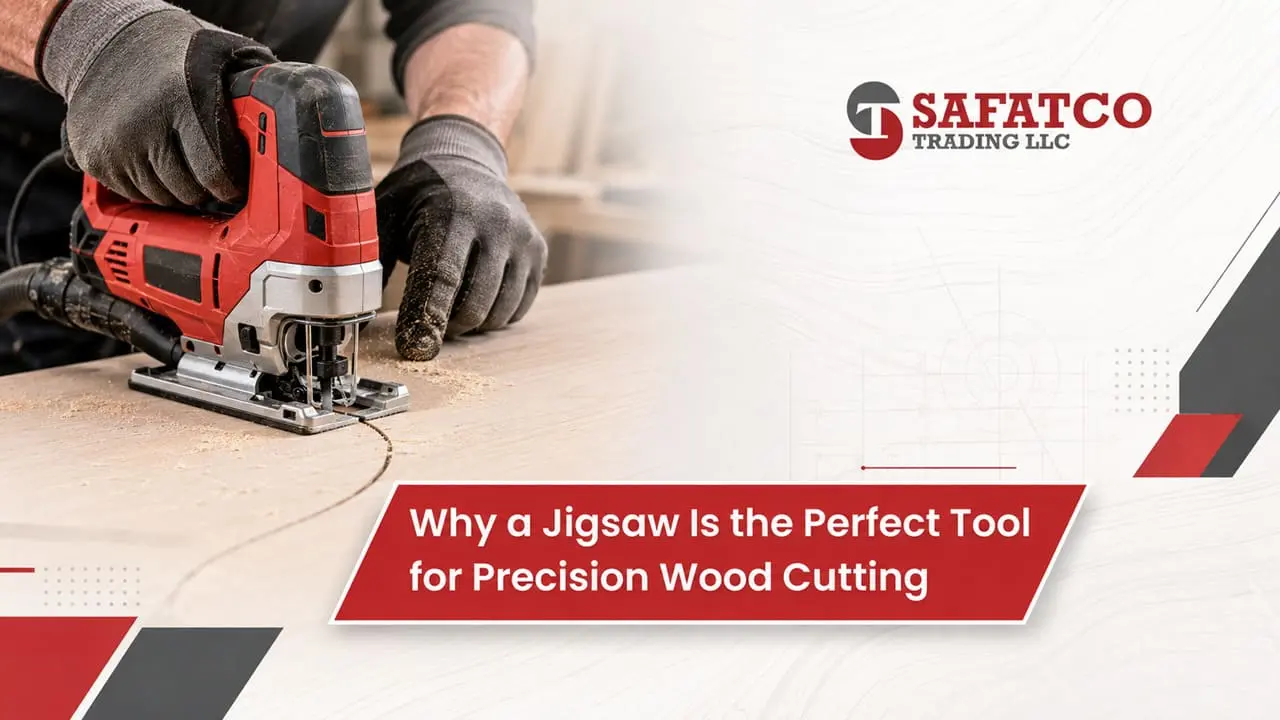
Why a Jigsaw Is the Perfect Tool for Precision Wood Cutting
But woodworking requires more than just making straight cuts. Maybe it is a curved edge for a cabinet panel, maybe it is a neat sink opening for your worktop or maybe it is bundle of detailed shapes for your decorative project. In these cases, a saw can seem very stiff, while a handsaw will require way too much effort. A jigsaw for fine woodwork is a more realistic compromise.
A jigsaw is the compact, flexible and easy to control tool that gets professional and DIY users through detailed cuts without buying large workshop machinery. But as important is the right blade paired with the correct technique can give you a clean cut on plywood, MDF, hardwood and laminated boards.
What Makes a Jigsaw Different?
It operates using a thin blade, which moves up and down within short range at high speed. Unlike most larger saws, its narrow blade can rotate as it cuts. With this freedom, the user can cut curves, circles, internal openings and irregular patterns.
Additionally, many of the jigsaws on today’s market have adjustable speed settings. This specific task enables users to align their cutting action with the material. Lower-speed is helpful for controlling the outcome in delicate work while higher speed is more productive in softer timber.
The small size of the tool also enables it to be used in workshops where space is a commodity. It makes it easy to bring to a job or on the workbench and simple enough to store afterward. Buy Bosch Jigsaw Machine GST-90BE.
Excellent Control for Curved and Detailed Cuts
This is one of the biggest jigsaw advantages for woodworking since it allows you to do curved cuts. And a wide blade will have a hard time following tight curves. With a narrow jigsaw blade, however, you are cutting along a line that is more easily moved to without much resistance.
As an example, furniture producers are proficient at cutting rounded edges of the table or likewise curved sections of ornamental racks, along with chair components. In the same way, it is possible for installers to form openings for sinks as well as to install electrical fittings or pipes and ventilation ducts.
For some people, plunge cutting is also possible with a jigsaw. Instead of having to start cutting from the outer edge of a wooden panel, users can now begin a cut inside one. This is quite useful when making internal cut-outs, but you’ll need the right technique and a compatible blade.
Suitable for Many Types of Wood
A quality electric jigsaw for wood cutting can handle several common materials, including:
- Softwood and hardwood
- MDF and chipboard
- Plywood
- Veneered panels
- Laminated boards
- Timber worktops
However, just as important as the power tool itself is simply blade selection. A blade of coarse tooth cuts faster, but will leave a harsher edge. Conversely, a fine-tooth blade is capable of leaving a smoother finish while cutting slightly slower.
Reverse-tooth blade of some type is the advised cut of choice to minimize chipping on an exposed surface for laminate or veneered boards. Conversely, thicker hardwood usually needs a heavy duty blade to cope with an acceptable tooth pattern. Buy 480W Variable Speed Pendulum Jigsaw.
Precision Without Heavy Workshop Machinery
While large band saws and scroll saws are highly accurate, they occupy dedicated space, as well as billing a bit higher. Similar cutting possibilities can be achieved with a professional jigsaw machine in a far more compact format.
This feature is a boon for carpenters, interior contractors, maintenance teams and home users who work across sites. However, the device is also capable of doing both rough cuts and finishings.
Not Every Saw Is Replaced By A Jigsaw However, it does a good job of handling numerous tasks and therefore helps limit the number of operating loss cutting machines one has to carry.
Features That Improve Cutting Accuracy
Modern jigsaws include several features that support cleaner and more controlled work.
| Jigsaw feature | How it helps |
| Variable speed control | Matches blade speed to the wood type |
| Orbital action | Improves cutting speed in thicker timber |
| Adjustable base plate | Supports straight and bevel cuts |
| LED work light | Improves visibility along the cutting line |
| Dust blower or extraction port | Keeps sawdust away from the marked path |
| Tool-free blade change | Allows quick blade replacement |
| Guide fence compatibility | Helps produce straighter parallel cuts |
Orbital action deserves careful attention. It moves the blade slightly forward during each stroke, which helps it cut faster. However, aggressive orbital settings may create a rougher finish. Therefore, users should reduce or disable orbital action when working on decorative surfaces or tight curves. Buy Makita 4350ct Jigsaw.
How to Get Cleaner Jigsaw Cuts
A jigsaw, if used properly, is a great tool for precise cuts. The first you have to do it is to mark the cutting line with a pencil or other appropriate method. After that is secure, clamp the material so it is not able to vibrate or move as you are cutting.
Then do not even touch the blade to wood until it gets up to full speed. Please try to push the jigsaw, instead of trying its force to help it a little bit. Pushing too hard can warp the blade, push the cut off line, or chip the edge.
Third, select a blade that is long enough to protrude beyond the bottom of the workpiece with each stroke. If the blade is too short, it may hit the bottom of the material and make for an unsafe cut.
Covering the cutting line with a piece of masking tape on visible surfaces may help to reduce splintering. Many times, a fine blade will improve on that even more, as will a splinter guard.
Buy Products on,
Why Professionals and DIY Users Prefer Jigsaws
Jigsaws are regarded as portable and versatile tools by experts. You can even use the same tool for cabinet installation, worktop cutting and custom trim work during the same project.
On the other hand, DIY users value the relatively small size and simplicity. With some practice, it can handle shelving projects, wooden signs, garden furniture, toy making and home repairs.
Additionally, jigsaws can be found in corded and cordless versions as well. Corded versions offer uninterrupted power for extended projects in the workshop. The cordless jigsaws though give you more freedom on job sites without an electrical outlet handy.
Related Articles:
» Makita Cordless Jigsaw – DJV181 Dubai Wholesaler Supplier
» Cordless Jigsaw Buying Guide
» Why Jigsaw Power Tools Are a Must-Have for Dubai’s Woodworkers?
» Choosing the Right Jigsaw Power Tool for Your Needs in Dubai
Choose Quality Jigsaws and Blades from Safatco Trading
Cutting performance is directly related to the quality of the jigsaw, blade and accessories. You can discover reliable power tools for working with wood, interior work and even particular maintenance and construction applications at Safatco Trading Dubai.
When selecting a model, keep in mind the wood type, depth of cut expected, how often you plan to use it and what level of accuracy is needed. Also, find out if it’s easy to source replacement blades and other compatible accessories. A right jigsaw will not only ease cutting; it can instead also contribute to safety, productivity and finishing quality of each project.
FAQs: Why a Jigsaw Is the Perfect Tool for Precision Wood Cutting
1. Is a jigsaw good for precision wood cutting?
A jigsaw suits that task beautifully, especially in jigging wood cuts as your project involves curves, internal openings or complicated shapes. Accuracy is relative to the blade, speed setting and user.
2. Can a jigsaw make straight cuts?
Yes, a jigsaw can cut straight if you use guide fences or clamped straightedge. On the other hand, if you need to make long, perfectly straight cuts quickly, a circular saw can be more efficient.
3. Which jigsaw blade gives the smoothest cut?
A fine wood saw blade tends to yield the cleanest cut. When working with laminated or veneered surfaces, a reverse-tooth blade may help minimize chipping from view.
4. Can a jigsaw cut thick wood?
Yes jigsaws do cut thick wood within their cutting capacity. However, if you’re cutting thick hardwoods you need a stiff and long blade and to properly control the feed rate.
5. Why does my jigsaw blade bend while cutting?
Reasons can be high-pressure, a dull blade, or an incompatible type of the blade. The tool should be allowed to cut naturally and damaged blades should be replaced immediately.
6. Should I use orbital action for wood?
Orbital action works well for fast cuts in softwood and thick timber. However, use a low setting or switch it off for fine curves and smooth finishing cuts.
7. Can a jigsaw cut circles in wood?
Yes, a jigsaw can cut circles and rounded shapes, mark a line, drill a starter hole for internal circles and feed the blade carefully along that line.
8. How can I stop wood from splintering?
Use a fine or reverse tooth saw blade; mask the cut line and provide good support. Cutting at a slower rate also minimizes splintering.
9. Is a corded or cordless jigsaw better?
We find that a corded jigsaw is better for long, continuous tasks but a cordless model gives you more portability. So it all depends on where you work and how often you expect to be using them.
10. Can beginners safely use a jigsaw?
After reading the instructions, wearing proper protection gear and if used following safety precautions you can safely use a jigsaw as a beginner. Try it on scrap wood before starting a finished project.
11. What safety equipment should I wear?
Use safety glasses, hearing protection and an appropriate mask. And, of course — no baggy clothes and no hands anywhere near the spinning blade.
12. Where can I buy a reliable jigsaw in Dubai?
Buy quality jigsaw blades and power-tool accessories from Safatco Trading in Dubai. Select a particular model by the criteria which includes cutting depth, speed control features, power source and day-to-day work load.