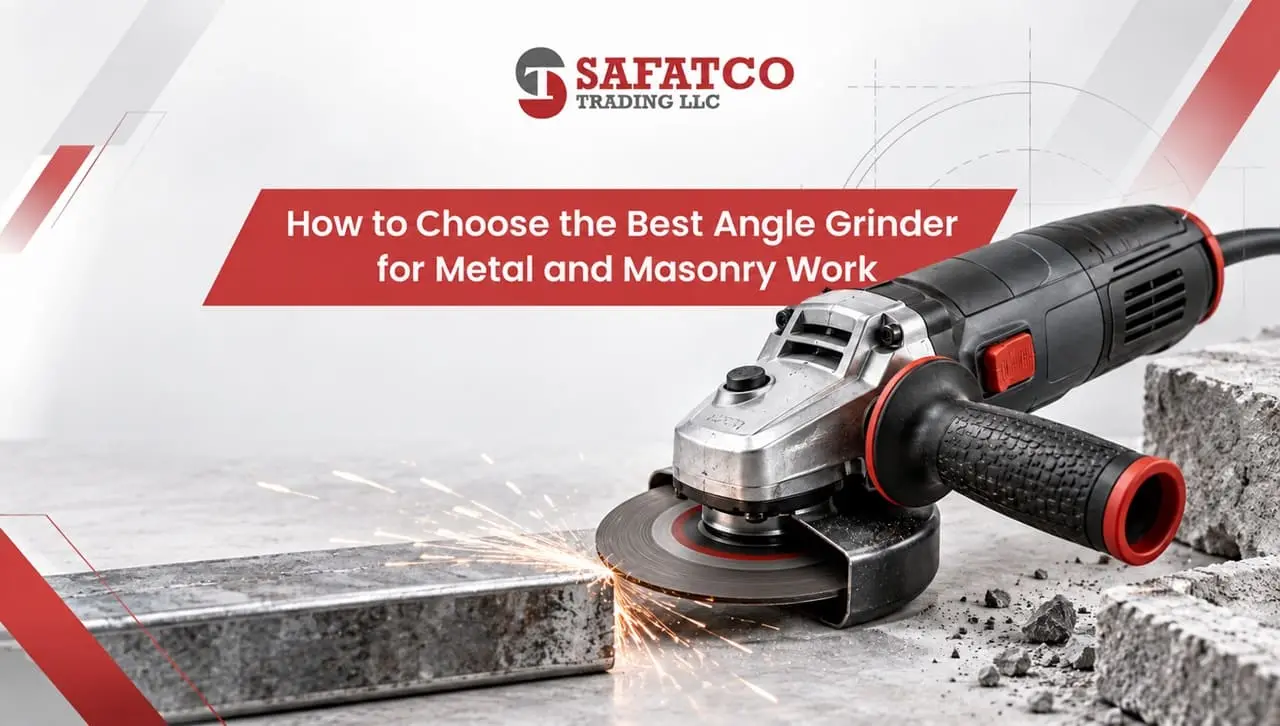
How to Choose the Best Angle Grinder for Metal and Masonry Work
Angle grinders do everything from trimming steel and getting rid of rust to cutting concrete, brick and stone. But even an easy job can become exhausting if you buy the wrong machine. Even more crucial is that the grinder should match the disc, material and workload.
Be it an angle grinder for metal cutting or one for masonry or just a single machine to take care of all the different jobs at your site, there are several factors you should give attention to before you make a purchase.
Start With the Material You Usually Work On
What will you be cutting or grinding most often? This work includes cutting steel bars, welding and rust removal. Conversely, masonry work typically includes concrete, blocks, brick, stone or tiles.
Hence, the next point is not to decide the machine based only on price.
Abrasive Grinding Wheels, Flap Discs, Wire Brushes & Metal Cutting Disc: These are the tools commonly used for metal grinding and cutting. If you are planning on doing the masonry work, stone wheels/diamond cutting discs will be necessary.
For example, Bosch lists diamond cutting discs for concrete, brick and soft stone materials and cautions that its grinder guidance states the accessory should be matched with application type. Buy Makita Angle Grinder 4″ 220V.
Choose the Right Disc Size
Disc diameter is one of the easiest ways to narrow down your choice.
| Disc Size | Suitable Use | Main Advantage |
| 115 mm | Light cutting, grinding and DIY work | Compact and easy to handle |
| 125 mm | General metal and masonry work | Good balance of power and control |
| 180 mm | Heavier fabrication and deeper cuts | Greater cutting capacity |
| 230 mm | Construction and demanding masonry | Deep cuts and higher productivity |
For most everyday workshop and maintenance jobs, 115 mm or 125 mm angle grinders provide good control. Meanwhile, larger machines suit deeper masonry cutting and demanding site applications.
Common professional cutting accessories are available across several of these diameters, including 115 mm, 125 mm, 180 mm and 230 mm.
Consider Motor Power
Next, check the motor rating.
A lower-powered machine may work perfectly for occasional light cutting. However, continuous fabrication, concrete work and repeated grinding can put considerably more load on the motor.
As a practical buying approach:
- Around 700–900 watts may suit lighter workshop and DIY jobs.
- Around 900–1,200 watts provides more flexibility for regular professional use.
- Higher-powered models make more sense for demanding cutting, construction and extended workloads.
However, more wattage doesn’t automatically mean a better grinder. Balance, cooling, reliability and the correct accessory matter just as much.
Check RPM and Disc Compatibility
Buyers then look at the RPM number and assume that more is better for speed. That can be misleading.
Rather, the key here is matching of speed between grinder and accessory rating.
An accessory’s rated speed must equal or exceed the maximum speed marked on the grinder. A failure can occur in an accessory exceeding its rated speed.
So, read the specification of both grinder and marking which is printed on the cutting or grinding wheel itself. Buy Makita Angle Grinder 4.5″ 115MM 220V.
Select the Correct Disc for Metal
If you mainly handle steel or fabrication work, consider what you actually want the grinder to do.
Use a suitable metal cutting disc for cutting sheet, pipes or steel sections. Meanwhile, use a grinding wheel for shaping metal and smoothing welds. A flap disc can provide a smoother finish, while a compatible wire brush helps with rust and paint removal.
Furthermore, don’t use a disc simply because it physically fits the grinder. Manufacturers specifically advise using accessories designed and recommended for the tool and application.
Choose the Correct Disc for Masonry
Concrete, brick and natural stone require different cutting characteristics from metal.
For example, diamond cutting discs for concrete and masonry are widely used because they can handle abrasive construction materials efficiently. Bonded stone-cutting discs are another option for suitable applications.
Bosch lists 115 mm and 125 mm stone cutting discs with a 22.23 mm bore, while its diamond products also cover common concrete and brick applications.
Consequently, always check whether the wheel specifically supports concrete, brick, tile, stone or whichever material you plan to cut.
Look for Useful Safety Features
A good professional angle grinder should provide more than raw power.
Depending on the model, useful features may include:
Restart protection – helps prevent unexpected restarting after a power interruption.
Soft start – reduces the initial kick when the grinder starts.
Anti-vibration handle – improves comfort during longer jobs.
Adjustable safety guard – helps shield the operator from sparks and debris.
Kickback protection – available on some advanced models and designed to improve control when a wheel suddenly binds.
Additionally, inspect accessories before every job. Cracked wheels, damaged backing pads or diamond discs with missing segments should not be used. Buy Makita Angle Grinder 4.5.
Corded or Cordless Angle Grinder?
A corded angle grinder normally suits workshops and long-duration work because power remains consistent. Moreover, you don’t need to stop and recharge batteries.
In contrast, a cordless angle grinder offers excellent mobility. Therefore, it may be a better option for maintenance teams, installation technicians and workers moving around construction sites.
However, frequent heavy cutting can consume battery power quickly. So, professionals usually consider battery capacity and spare battery availability before selecting cordless equipment.
Buy Products on,
» Makita DGA452RTJ 18v Lxt Cordless Angle Grinder
» Bosch Angle Grinder 9 Inch GWS 20-230
» Bosch Gws750-115 Angle Grinder 4.5
» DEWALT Angle Grinder 7″ 2200W 110V
» Dewalt Angle Grinder 4 1/2″ Slider Switch
Don’t Ignore Ergonomics
Even a powerful grinder can become uncomfortable if its body feels bulky.
Therefore, check the grip diameter, auxiliary handle position, machine weight and switch location. A grinder that feels balanced will usually provide better control, particularly during overhead or detailed work.
This matters even more when the machine is used for several hours.
Related Articles:
» Makita Angle Grinders for Cutting Grinding & Polishing
» Bosch Professional Brushless Angle-Grinder: GWS 180-Li
» How to Choose the Right Angle Grinder for Your Needs in Dubai?
» Angle Grinder Power Tools: Uses and Maintenance Tips
» Everything You Need to Know About Angle Grinders and Its Uses
Buy Based on Workload, Not Only Price
A budget machine might be fine for occasional home use only. But when it comes to durability, availability of spare parts and accessories and customer support access, trades people should be a bit more choosy.
Specifications are the main thing to choose from when selecting angle grinder Dubai rather than going by price alone.
Using the right disc on a good grinder can result in better cutting speed, surface finish and operator control. More importantly, the appropriate tool will also mean that less strain is put on your machine.
FAQs: Choose the Best Angle Grinder for Metal and Masonry Work
1. Where can I buy an angle grinder for metal and masonry in Dubai?
Customers are looking for quality professional power tools, Safatco Trading – Dubai can help it out angle grinders for workshop, fabrication, maintenance and construction applications.
2. Is a 115 mm or 125 mm angle grinder better?
If you want a smaller, more convenient but lighter grinder then a 115 mm is ideal. Still, in most cases a slightly larger 125 mm angle grinder has a bit more cutting capacity but is still very usable for everyday jobs in the workshop.
3. Does Safatco Trading – Dubai supply angle grinders for professional users?
Yes. Safatco Trading – Dubai manufactures tools for professional users working in fabrication, maintenance, construction and related applications. Selection must still be based on: power, disc size and workload.
4. Can one angle grinder cut both metal and concrete?
Yes, provided you use the correct disc for each material. Do not use a steel cutting wheel in place of the correct masonry accessory.
5. How can Safatco Trading – Dubai help me choose the right angle grinder?
Safatco Trading – Dubai can help customers compare tool specifications according to material, application, disc diameter and expected workload so they can select a more suitable machine.
6. What size angle grinder is suitable for general-purpose use?
For many users, 115 mm and 125 mm grinders offer a practical balance between handling, cutting capacity and accessory availability.
7. Can Safatco Trading – Dubai provide grinders for masonry applications?
Yes. Customers can approach Safatco Trading – Dubai when looking for grinders suitable for construction and masonry-related work. Always pair the machine with an approved masonry or diamond accessory.
8. What wattage angle grinder should I choose?
Light jobs can often use a lower-powered model, whereas professional fabrication and masonry applications normally benefit from greater motor power and better duty capability.
9. Can an angle grinder remove rust?
Yes. An angle grinder fitted with an appropriate wire brush, abrasive disc or flap disc can be used to clean rust, old coatings and surface contamination from metal.
10. Why choose Safatco Trading – Dubai for power tools?
Safatco Trading – Dubai provides power-tool solutions for users across workshop, maintenance, construction and industrial applications, making it easier to compare equipment according to real job requirements.
11. Are diamond blades suitable for masonry cutting?
Yes. They’re suitable for concrete, brick and stone and are widely available in diamond cutting discs. But before using, refer to the specifications of the blade because not all diamond discs fit masonry material.
12. What is the most important thing to check before fitting an angle grinder disc?
Check the disc diameter, bore size, application and rated speed. Most importantly, the accessory’s rated speed must not be lower than the grinder’s maximum operating speed.